Now that there are no mandatory writing assignments, no tests, and no set curriculum, let’s explore ways to keep learning and make a difference outside of school. This week, I’ll share some resources and quick tips for writing to your mayor, city council member, president, or Congressional representative. This is the first of a weekly series– so subscribe, engage, and then share to your own blog!
USA.gov makes it easy to find info on your US House of Representatives, State assembly, and even city council members.
So, between COVID-19 and the ways it is affecting low-income communities and BIPOCs more than the general population…and the death of George Floyd… and what happened in La Mesa last weekend, many of us are feeling strong feelings about different topics. It’s really easy to feel overwhelmed by the news and helpless as to what might be done. Especially if you’re a student, without an income stream to make a donation or show support outside of social media.
What we can do from home is write letters!
Lisa Simpson was definitely my ‘spirit cartoon’ when I was in school.
While letter-writing might make you think you’ve got to find stamps and envelopes and work on your handwriting, the most efficient way to contact your elected officials these days is (of course!) through email.
Who do I write to?
~Go to USA.gov and find out who is representing you and your family in the local, state, and national levels. Consider joining those people’s email lists– you’ll receive a weekly message and learn about that politician’s priorities. That way, if they’re not saying anything about a topic you feel is really important to address, you can call them out, and then suggest what you want to see them say, do, or vote for.
Prefer reading instructions and navigating things in Spanish? USA.gov is available in Spanish too! Click here.
Something to consider is: what scale of change do you want to see? If you want something to change about specifically your city, write to the mayor and/or city council member.
How do I structure the letter?
I’m not an expert, but here is a basic outline:
1
Introduce yourself. Explain who you are, and why your voice matters.–> Just a few sentences
2
Describe the issue (JUST ONE!)–> It’s great to care about several topics, but be strategic and focus. You can always send a second letter.
3
State your opinion & offer a suggestion or solution –> Nobody likes it when someone complains, but doesn’t offer a suggestion.
4
Ask the person to take action–> “I am asking you to vote yes on…..” or “I am imploring (stronger than asking) you to speak out in the next city council meeting….” etc.
5
“Thank you in advance,” “Thank you for your time,” etc. –> Gotta be polite.
6
“Sincerely,” [Your Full Name] or “Respectfully,” [Your Full Name] + add your mailing address underneath
DON’T FORGET TO PROOFREAD! If somebody can’t understand what you’re trying to comm
“Officials are more often swayed by personal stories than by impersonal statistics, no matter how telling those statistics may be.
I feel like I don’t know enough to write. How can I learn more?
~Check out Do Something.org to learn more about whatever issues matter most to you. It’s a site especially for young people, with how-tos, youth-focused news, and more.
~Check out this really long page on writing letters to elected officials from KU (University of Kansas)
Don’t be afraid to get started! Stay tuned next week for an insider’s perspective on what works best when writing to your elected officials with Zack Brown. So, what kinds of changes might you want to see in our world?
In 1839, English writer Edward George Bulwer Lytton wrote: “The pen is mightier than the sword.” Words are so powerful that strong words–whether of love or hate–persist in our memories far longer than either a hug or a hit.
Blogging takes the mighty pen (or keyboard, really) and combines it with visuals. Because humans are wired to process visual information much faster than writing, blogging has the capacity to inspire, motivate, and inform your readers in a way that traditional essay-writing cannot.
Start here with this 10-ish minute video to take you through the first steps of starting a WordPress account from scratch.
Don’t have the time or energy (or cares) to watch the video? Ultra-fast recap: create a sign-in, don’t purchase or select a domain; select the cheapest paid plan ($4/month); then when it takes you to your shopping cart, click the trash can icon next to any charges. NOTE: If you’re starting this on a phone, the little trash can icon is wayyyy down at the very bottom of the purchase page. Sneaky.
Next steps: Work through the Site Setup List
Remember, you are naming your site, not your assigned post for the week. Your website is basically the book that you’re writing (and publishing!) of your life.
Because this is a blog that is totally yours….but assigned for English class…consider what content you’ll be adding. If you don’t plan on creating or publishing anything outside of the class assignments, consider that as you name your blog.
DON’T FORGET: Check your email and confirm your email address. This is a super-easy, 30-second step, but your blog won’t publish without it.
Take some time to make your homepage…home-y.
Yes, you absolutely need to do this part. If not, your site will look totally generic. The templates available–even with the free version of WordPress–are quite visually appealing, and they are laid out nicely.
But nice layouts don’t mean anything if you don’t personalize them, replace the pre-loaded pictures, and make it all reflect who you are.
Last section: LAUNCHING!
Once your site has a title and you’ve customized your homepage (and saved settings every step along the way), click this big button to the right side of your home screen.
Get ready to pass through the last gauntlet of WordPress making it look like you have to pay money!
I promise, you don’t have to pay.
WordPress will try to sell you on a paid plan and a unique domain again. At the bottom of your options, look in the bottom righthand corner. Click SKIP PURCHASE.
Oh wait. Another request that you buy a plan? Surprise.
We’re smarter than the marketers! Go ahead and click “Continue with your free site.”
Congratulations! You made it through 4+ attempts at making you pay, and now have a free WordPress blog! Now go and become an awesome blogger.
Sharing is caring! If this helped you, pay it forward.
“Write a blog post,” your teacher said. “Make it about whatever you want,” she said. And now, you’re staring at an intimidating blank blog document that looks something like this:
Not to worry, I’m going to take the hours of research and time spent tinkering around with my own new blog and break it down for you. Remember, you already have years spent practicing writing in school, and you’ve probably spent thousands of hours looking at memes, photos, infographics, and other web-based content. But now, instead of simply consuming content, it’s your opportunity to create.
Mostly it’s about how you organize, enhance, and present your thoughts, ideas, questions, and quotes.
What are these “7 things” and why can’t there only be 2 or 3? Well, blogging is generally an essay, using 1st-person POV at times, plus the ‘special sauce’ of multimedia content, eye-catching design, and hyperlinked references. My student-specific tips are a combination of my experience as a secondary English teacher, along with learnings from Hubspot, an excellent resource for learning more about blogging and marketing. I’ll briefly address introductions, conclusions, and how to type up your blog posts, but mostly it’s about how you organize, enhance, and present your thoughts, ideas, questions, and quotes.
1. Give your post a descriptive title (with clarification like this)
Thanks to the Internet, people can find thousands of different answers to millions of different questions. While this is one of the more awesome features of living in the 21st century, it might also make it more challenging for you, a new blogger, to capture a reader’s attention. This is why your descriptive (not too general), clear (not vague) title is so important. Hubspot writer, Sophia Bernazzani, explains:
Internet readers have very short attention spans — around eight seconds in length — and the headline is one of the critical first elements that help readers decide if they want to click and stay on your site.
Sophia Bernazzani
To give specific advice for students blogging for English class, consider that every blog post has a point, a purpose, a main message, a claim. Whatever term you prefer to use, the point is, you need to have a point. Make sure your title clarifies this for a potential reader by using your claim as a title. Here is an example of a recent literary blog post that uses the title to inform readers about the author’s claim:
2. Choose a featured image to draw attention
We may say “never judge a book by its cover,” but we all do it. Your featured image is like the cover to the ‘book’ that is your blog post. And like any good book cover, you want it to be appealing, to relate to the text inside, and to set the tone or ‘vibe’ that your potential reader may be seeking.
This blog, which analyzes and compares the film, Little Women (2019) with the original novel, includes a screenshot of three male characters. Since it’s clear from the title that the blog post is about ‘no bad men,’ we can see that the title and featured image are working together like a book title and its cover art: they appeal to a certain reader both with words and images.
Make sure you don’t steal images that aren’t available for your use. Negative Space is a site that offers a pretty solid selection of images for you to use: https://negativespace.co/
3. Write an introduction
Just like with a multi-paragraph essay, you’ve got to convince your reader to spend their precious time paying attention to what you have to say (or write). Hook readers with whatever fits your writing style, your personality, and your blog’s subject. Common intro starters include:
A question
A powerful quote
A surprising or intriguing fact or statistic
An anecdote (short personal story)
A provocative statement (“provocative” as in, provoking a response. People might disagree or agree strongly)
For example, if we return to Rachel Zarrow’s post on Little Women, we might appreciate how she begins with a provocative statement:
“I love reading novels about bad men. At least I thought I did.”
The Best Part of Little Women is that It Contains No Bad Men
That makes someone want to keep reading. Why? Because it makes you wonder what kind of person this writer is, and then perhaps feel curious as to why she’s changed. She thought she “loved reading novels about bad men”…. Until watching Little Women? Intriguing.
Practical Tip: Break up your text more than you would in an academic essay. Really short paragraphs are totally fine (just a couple sentences).
4. Use sub-headers to organize and break up the post
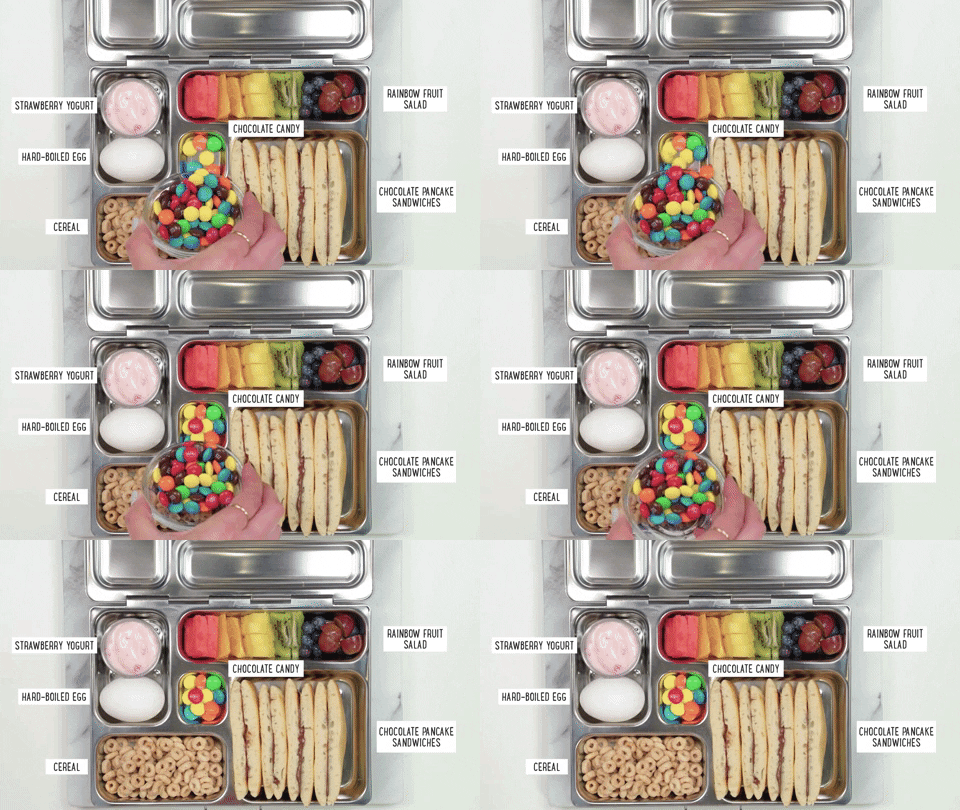
Sub-headers are an extremely important tool for keeping organized and cutting your beautiful paragraphs, your powerful quotes, and your deep thoughts into more manageable chunks. If your blog post is like a meal, then sub-headers turn it into a bento box, with neat little sections.
Yum , delicious organization.
Let’s look at Jake Eagle and Michael Amster’s post from Greater Good Magazine:
In the article, “Stuck at Home? How to Find Awe and Beauty Indoors,” the authors use the three letters in the word, AWE, to organize and divide the article. This helps readers to keep going and helps you, as a writer, to stay organized.
Practical tip: Try to follow the ‘rule of 3’: it’s a pleasing number, and it seems more meaningful and worth someone’s reading time than just 2 ideas. Also, don’t go for a really high number like 7. This post is taking quite a bit of time from research, planning, writing, and editing!
5. Write your blog in a word processor first.
I’m giving you this advice from first-hand experience. Trust me: it’s SO much easier doing your thinking-with-written-words in a word processor, like Word or Google Docs. You’re used to it, and you can focus on your ideas first.
Do everything you’re able to find and fix any and ALL spelling, capitalization, punctuation, & grammar errors. Try out Grammarly! You’ll find that by writing every week, AND carefully re-reading and revising your posts, your writing will improve over time.
6. Embed multimedia content and include hyperlinks
This is the ‘special sauce’ that makes blogging special and, in some ways, better than a regular essay. This cool infographic featured in an Entrepreneur article visually explains why people naturally respond faster and better when there are images, not just words.
An excerpt of Entrepreneur‘s impressive infographic on visual processing
Why hyperlinks? Because they’re the ‘works cited’ style of blogging. You reference your sources, which is the ethical and honorable thing to do, and because plagiarism is an academic crime. But deeper than that, hyperlinks promote curiosity. They give readers the opportunity to dive deeper into a section of your post that interests them most.
Practical Tip: If you’re brand-new to text-editing and don’t know how to hyperlink: 1.) highlight the word(s) that you wish to turn into a link
2.) click the icon that looks like little chain-links; 3.) paste your link and hit Return/Enter.
7. Conclusion: you have to write one
Your conclusion doesn’t have to be long, but it does have to exist. Why? Because it’s polite! Have you ever noticed that when people talk on the phone in TV or movies, they often don’t conclude? It’s weird and unrealistic.
Wrap up and summarize what your post has been about. If you’re really stuck and don’t know what to write, ask yourself,
So what?
What is the significance of your blog topic? Why does this matter to you, to others, or the world?
Don’t freak out. We will get through this together…and even begin to have some fun with a unique writing form.
Want to learn even more? Jump down the rabbit hole!
Here are a few articles and blog posts about blogging (how meta!) that I referenced while writing this post:
What is that circled line missing? A comma! Commas are crucial tools for separating thoughts and ideas, whether they be as small as a list of symptoms, or a big as your greatest new idea. Let’s go over 2 ways commas can be used to create more complex sentences.
Comma + conjunction
This is the most common way to combine 2 independent clauses (i.e., 2 complete thoughts). The key is to use a conjunction that helps communicate what kind of connection you’re making between the 2 thoughts.
and, but, or, for, yet
These are your conjunctions: the ‘tape’ or ‘pushpins’ to connect 2 thoughts…plus a comma!
Example 1: Take this excerpt from Alexxandra Shuman’s essay, “The Essentials to Happiness”:
Happiness is a journey. Everyone seems to need different things to be happy. But I believe people are blinded from what truly makes one happy.
We could combine sentence #1 and #2 using AND, BUT, or YET. All work, and change the ‘flavor’ of the piece. Or, we could easily combine sentence #2 and #3, because the BUT is already there:
Happiness is a journey. Everyone seems to need different things to be happy, but I believe people are blinded from what truly makes one happy.
An appositive is the technical term for a phrase (or word) that gives more information about a noun…generally the subject of your sentence or paragraph. This is a great wayto make your writing more concise and less choppy.
You are using appositives every time you provide contextual lead-in to your text evidence using this writing style:
Iago, the antagonist of Shakespeare’s play, Othello, thinks that women are inferior to men.
Our example claim sentence from writing analytical paragraphs on characterization
Example 1: Here’s another excerpt from Alexxandra Shuman’s essay, “The Essentials to Happiness”:
“I spent the day with a nine-year-old girl named Marilyn. She took me to her house to meet her parents.“
I could revise this by using an appositive: Marilyn, a nine-year-old girl, took me to her house to meet her parents.
One last thing: use commas for list items and to connect 2 thoughts using a conjunction… but DON’T just throw it in carelessly. That’s a comma splice.







 8th grade English @ CVLCC